
Quick Answer: Yes, when the approach matches the kind of neck pain you have. Deep Relief starts every neck pain visit by finding out whether the cause is muscle tension, an old injury, or a pinched nerve, then works the three neck zones in our DR Hit The Spot™ method that drive most headaches, stiffness, and radiating pain.
If you’ve been rubbing the same spot at the base of your skull for weeks and nothing seems to loosen it, you’re probably wondering whether massage actually helps or if it’s just a temporary distraction. Honestly? Yes.
When the right approach is used for the right kind of neck pain, the relief tends to hold instead of fading by the next morning. We built our clinic around figuring out which kind of neck pain you actually have before we put hands on you.
Neck pain is not one single problem. It shows up differently depending on the cause, and that matters more than most people think. That’s why we spend the first few minutes of every visit asking questions instead of jumping straight in. As a reliable massage provider in Austin, we want to make sure what we do actually fits what you are dealing with.
Most of the neck pain we see in Austin traces back to one of three sources. Muscle tension from posture and screen time is the most common, followed by an old injury that never fully resolved, and then a nerve that’s getting pinched somewhere along its path.
Desk workers make up a huge share of our neck pain clients. It’s almost always the same pattern, you know, forward head posture pulling on the muscles at the base of the skull and top of the shoulders until they just lock up.
The nerve-related kind feels different. Instead of a dull ache, people describe burning, tingling, or a sharp zing traveling down into the shoulder or arm. That usually means a muscle or joint is pressing on a nerve somewhere in the neck, and it needs a slightly different approach than plain tension does.
Figuring out which one you’re dealing with is the first real step, and it’s one we don’t skip. Our goal is to provide long-term pain relief that actually fits what your body is dealing with, not just something that gets you through the week.
Once we know what we’re working with, our signature deep tissue massage becomes the starting point for most neck cases. We use a protocol called DR Hit The Spot™, developed by our founder, Dr. Lou (Louisa Tomaio, D.Ac.), from more than 20 years of clinical practice. It works through seven specific zones of the body in a set order rather than wherever feels tight that day.
For neck pain, that means close attention to the base of the skull, the base of the neck, and the front of the neck, since those three zones cause most of the headaches, stiffness, and radiating pain our clients come in with.
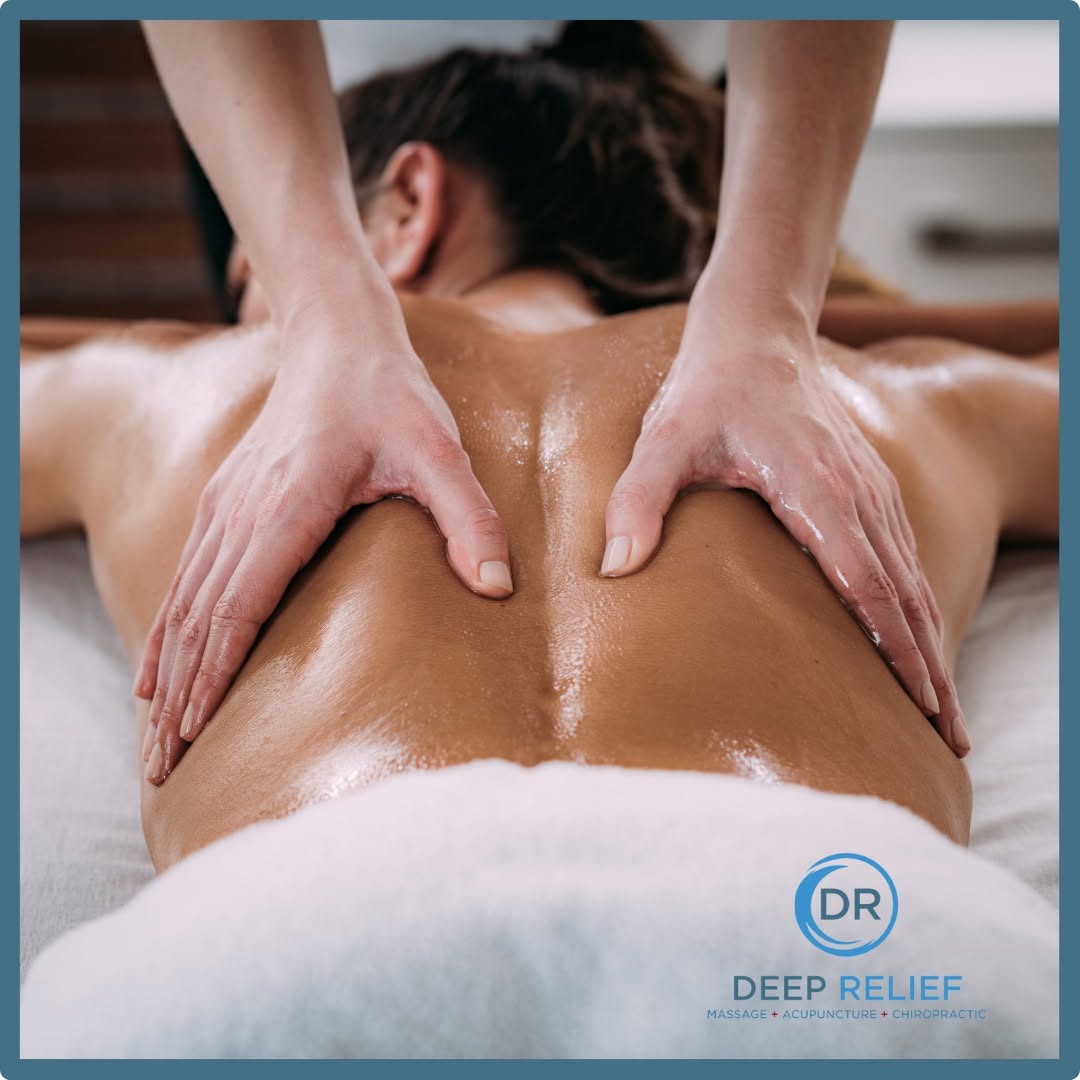
We don’t treat every neck the same way twice. A construction worker with years of overhead strain needs a different amount of pressure than someone who just started feeling stiff after switching to a standing desk. Our Perfect Pressure Number System is how we track that in the moment, so the pressure and pacing actually match what your muscles need that day.
The suboccipital muscles at the base of your skull are usually the first thing we check, since they’re notorious for triggering tension headaches people don’t realize started in the neck. Right below that, the levator scapulae and upper trapezius tend to hold onto stress in a way that creates that classic knot between the neck and shoulder blade.
We work these areas with long, deliberate strokes to warm the tissue, then move into targeted pressure once we feel where the real problem sits.
On the front side, the sternocleidomastoid and scalene muscles get overlooked constantly, even though they’re a frequent source of jaw tension and the kind of tension headache that radiates toward the eyes. Most massage places skip the front of the neck because it feels unfamiliar to work on, but we treat it as a standard part of the sequence, not an optional add-on.
| Cause | What It Feels Like | How We Approach It |
|---|---|---|
| Muscle tension | Dull ache, tight band across shoulders | Deep tissue work through the DR Hit The Spot™ zones |
| Old injury | Stiffness that never fully resolved | Slower pacing, closer attention to guarding and scar tissue |
| Pinched nerve | Burning, tingling, or a zing into the arm | Massage often paired with acupuncture |
Desk workers make up a large chunk of our neck pain clients, but they’re far from the only ones. We also see people recovering from car accidents, athletes dealing with training-related tightness, and folks whose neck pain showed up out of nowhere after a bad night’s sleep.
Each group tends to respond differently, which is why our team spends real time understanding your specific situation before deciding on a treatment plan.
For nerve-related neck pain, we sometimes bring in additional support beyond massage. Our acupuncture services can help calm an irritated nerve pathway when tingling or radiating pain is part of the picture.
Your visit starts with a short conversation about where the pain sits, how long it’s been going on, and what makes it better or worse. From there, we move through the DR Hit The Spot™ sequence with extra time in whichever neck zones are flagging as tight or tender, checking in throughout with the Perfect Pressure Number System so the work stays helpful rather than tipping into discomfort.
It’s normal to feel a little sore for a day or two after a deeper neck session, especially on your first visit. That soreness is usually a sign the tissue is responding, not a sign something went wrong. If there’s also a structural or alignment piece behind your neck pain, we may suggest pairing massage with chiropractic care so both sides get addressed.
For muscle-related neck pain, targeted deep tissue work can produce lasting relief, especially when paired with attention to posture and repeated over a few sessions. For nerve-related pain, massage often needs to be combined with acupuncture or chiropractic care to address the root cause.
Desk-related neck pain usually builds slowly and responds well to consistent, targeted massage. Injury-related neck pain often has a specific onset and may involve inflammation or nerve irritation, so we typically recommend a more layered approach.
Yes, both. The front of the neck, including the scalenes and sternocleidomastoid, is part of our standard seven-zone sequence, and skipping it means missing a common source of jaw tension and radiating headaches.
Many clients feel looser after a single session, especially for recent tension. Longer-standing or nerve-related neck pain usually responds best to a short series of visits.
We’re here to help you feel better, whether you have questions about our services, want to book a session, or simply need guidance.
Phone: (512) 529-0027
Email: [email protected]
Address: 7101 State Highway 71, Ste A-1, Austin, TX 78735
Hours: Monday-Friday 10 AM-7 PM | Saturday & Sunday 10 AM-6 PM