

Chiropractic care improves posture by restoring motion to spinal segments that got stuck in a compensating position. Soft tissue work and movement coaching then hold that change in place. Posture is basically a habit your joints and muscles have agreed on, which is why standing straighter for ten minutes achieves pretty much nothing lasting.
Deep Relief runs as a reputable massage clinic with two chiropractors and a full therapy roster, all in one Oak Hill building. Alignment work does not stop at the adjustment here, either. Dr. Eydi and Dr. Sean assess how your spine moves rather than just how you stand still. The useful question is which segment stopped moving, not whether your posture looks bad.
Rounded shoulders and a forward head are really just the visible end of a longer chain. Hours of sitting shorten the pectoralis muscles across the chest and lengthen the rhomboids between the shoulder blades. The thoracic spine loses extension because nothing ever asks it for any. Shoulders roll forward because the structure behind them stopped resisting.
The head follows, because once the upper back rounds, the neck extends to keep your eyes level. That loads the suboccipital muscles and the cervical joints beneath them. What looks like a slouch, honestly, is just a stack of adaptations, each reasonable on its own.
Willpower does not reverse that stack, which is the part most posture advice skips. You cannot hold a position your thoracic spine no longer reaches, no matter how much you want to. A week of trying usually just produces mid-back soreness instead of the long-term pain relief you are actually chasing.
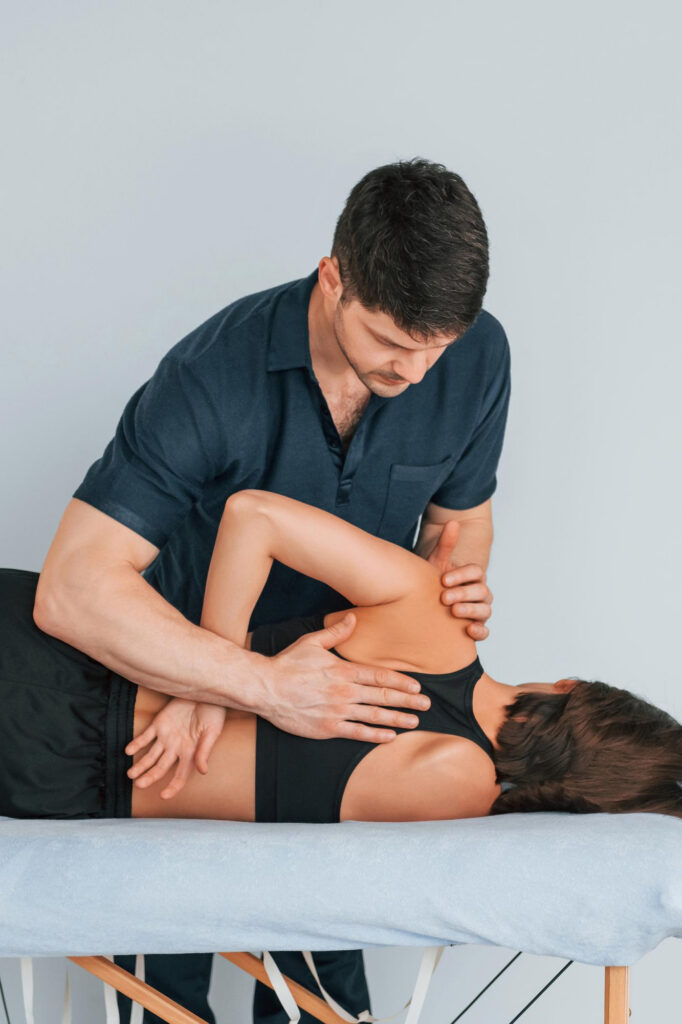
An adjustment gives a restricted segment its full range back. In the thoracic spine, that often means restoring the extension the rib cage has lost. The shoulders can then sit back without much conscious effort at all. Clients frequently report that breathing feels easier afterward, since a mobile rib cage expands a bit differently from a fixed one.
Our chiropractors work through the whole region rather than just the single sore spot. Adjusting one segment while its neighbors stay locked tends to produce relief that unwinds within days.
Assessment therefore covers the cervical, thoracic and lumbar regions together. Lifestyle coaching folds into the visit too, including workstation height, monitor position, and sleep positioning.
Instrument-assisted adjusting handles the thoracic spine comfortably for people who just do not like being rotated. Low-force impulses restore segmental motion without the setup traditional chiropractic adjustments usually need. That makes it practical for clients stiff enough that positioning alone feels uncomfortable.
Muscle is what actually holds your posture between visits. A pectoralis minor that has been short for three years will pull the shoulder forward again, whatever happened on the adjusting table. No amount of scapular squeezing overrides it, because the tissue itself has to lengthen.
Our therapists work the chest, the anterior neck, and the upper back zones inside the DR Hit The Spot™ sequence. Those are exactly the muscle groups postural adaptation tends to recruit. Sustained pressure and muscle stripping change tissue length in a way stretching just does not reach, particularly where adhesions have formed.
Where a specific knot keeps reasserting itself, trigger point therapy is the more direct tool. Targeted pressure gets at that kind of spot in a way general work tends to miss.
Noticed one shoulder sitting lower than the other, or a knot that just will not let go no matter what you try at home? Give us a call at (512) 529-0027, and we will take a look before it turns into a bigger problem.
Some postural problems are less about general tightness and more about one structure behaving badly. A shoulder that sits lower, a hip that hikes on one side, or a winging scapula all fall into that group. Those cases call for assessment-driven soft tissue work rather than a general session.
Our orthopedic massage sessions are built for exactly that. The work moves through muscle, fascia, and joint to address the root of a restriction rather than just the ache it produces. Holly, Cori, Finnick, Hector, Candice and Hope all carry that training, so scheduling around it is usually pretty straightforward.
Pairing it with chiropractic care tends to speed things up, too. The adjustment opens up the range while the orthopedic work retrains the tissue moving through it. Together, they give the new position somewhere to actually live.
Nobody reverses a decade of desk posture in three visits, as nice as that would be. Early change usually shows up as less end-of-day fatigue between the shoulder blades.
Then a neck that turns a bit further, and eventually a resting position that no longer feels like effort. The visual change arrives last, which tends to frustrate anyone expecting a before-and-after photo by week two.
Consistency matters more than intensity in work like this. Clients who come in regularly across a stretch of months see the alignment hold. Those who only show up during flares keep resetting to where they started, which is kind of frustrating when you think about it. Spacing between sessions changes the results about as much as the sessions themselves do.
Braces and straps hold you in a position without actually restoring the motion to get there yourself. That is why the relief disappears the moment they come off. An examination tells you which segments are restricted and which muscles hold the pattern. That information changes what you should actually be doing each day.
Both chiropractors and the full therapy roster work from our clinic in Austin, TX, and getting started is pretty simple.
Book now online, or give us a call at (512) 529-0027 if you would rather talk it through first. We are open Monday through Friday from 10 am to 7 pm, and Saturday and Sunday from 10 am to 6 pm.
Related Topics: